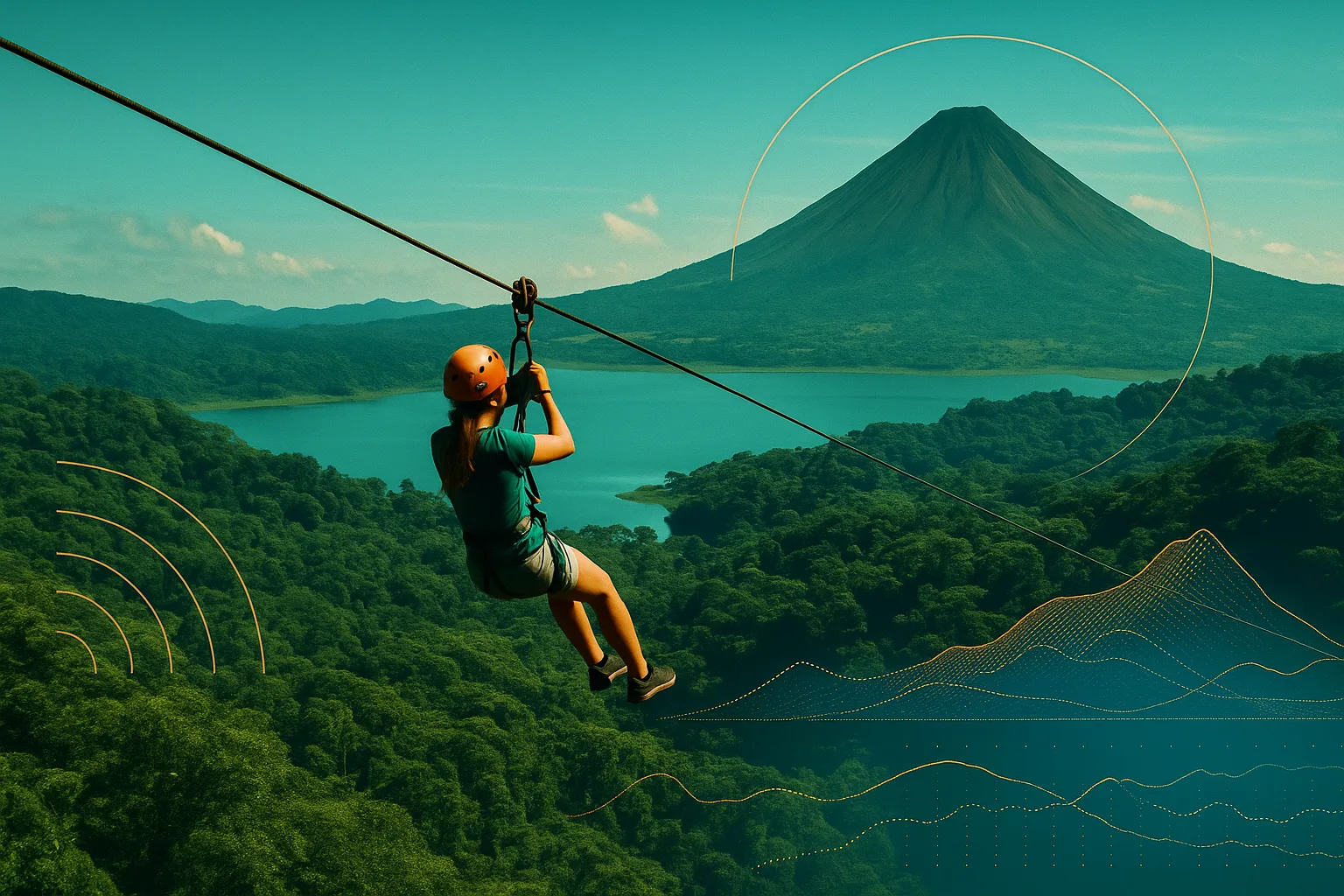
Tour operators face a brutal commission problem. Platforms like Viator and GetYourGuide charge 25-30% on every booking, and for most operators those platforms account for the majority of revenue. When a Costa Rica-based adventure tour company came to palmtree.ai’s travel GEO agency, they were handing over nearly a third of every dollar earned to aggregators while their own website sat collecting dust.
Forty-five days later, three out of five AI engines were citing them for “best adventure tours in Costa Rica.” Direct website bookings had jumped 280%. Monthly commission savings: $3,800.
Here’s exactly what happened.
The Challenge
The company (we’ll call them “Arenal Edge Adventures”) operates out of La Fortuna, the adventure tourism capital of Costa Rica. Their lineup includes zip-lining through cloud forest canopy, Class III-IV white water rafting on the Pacuare River, Arenal Volcano hiking tours, canyoneering, horseback riding to hidden waterfalls, and multi-day adventure packages.
They’d been running for eight years with a solid reputation: 2,800+ reviews across platforms averaging 4.7 stars, a team of 22 bilingual guides, and safety certifications from the Costa Rican Tourism Board. The product was excellent. The distribution model was killing their margins.
Seventy percent of bookings came through Viator and GetYourGuide at commission rates between 25% and 30%. Another 20% came through hotel concierge referrals (10-15% commission). Only 10% were direct website bookings, mostly from repeat customers or word-of-mouth.
The owner had tried traditional digital marketing: Google Ads, Facebook campaigns, influencer partnerships. Results were inconsistent and expensive. Cost per acquisition through paid channels was running $35-50 per booking, making the math barely better than OTA commissions on lower-priced tours.
What the owner hadn’t considered was that the game had shifted. Travelers weren’t just searching on Google anymore. They were asking AI engines: “What are the best adventure tours in Costa Rica?” and “Is zip-lining in La Fortuna worth it?” and “Compare white water rafting options near Arenal Volcano.”
Arenal Edge Adventures appeared in none of those answers.
What We Found
Our initial AI Travel Score audit revealed the full extent of the problem.
Overall AI Travel Score: 8/100
| AI Engine | Visibility Status | Mentioned? | Context Quality |
|---|---|---|---|
| ChatGPT | Not found | ❌ | N/A |
| Perplexity | Not found | ❌ | N/A |
| Google Gemini | Not found | ❌ | N/A |
| Claude | Not found | ❌ | N/A |
| Microsoft Copilot | Not found | ❌ | N/A |
Complete invisibility. The 8 points came from fragmented third-party mentions on travel blogs and review aggregators, none of which were structured enough for AI engines to confidently use in recommendations.
Root Cause Analysis
The diagnostic revealed six core issues:
Website built for humans, not AI. The site looked professional but was image-heavy with thin text content. Tour descriptions were 80-120 words each, far too sparse for AI engines to extract meaningful recommendation data.
No structured data whatsoever. Zero schema markup. No TourProduct, no TouristAttraction references, no FAQ schema, no aggregate ratings on-page. AI engines rely heavily on schema to understand what a business offers.
No llms.txt. Like most tour operators, they had never heard of the file and had no machine-readable business summary.
Content desert. The blog section had two posts from 2024 about “Top 5 Things to Do in La Fortuna,” both under 500 words and virtually identical to hundreds of competing articles.
Review fragmentation. Reviews were scattered across Viator, GetYourGuide, TripAdvisor, and Google without any unified strategy for response or amplification.
Social media inconsistency. Active on Instagram (sporadically), absent from Pinterest, TikTok, X, Facebook, and YouTube. No content calendar, no strategic approach.
The Strategy
We built a 45-day sprint plan focused on speed to AI visibility. Tour operators and DMCs face unique challenges in the AI landscape because they sell experiences rather than physical properties, requiring a different content and schema approach.
Phase 1: Technical Rebuild (Days 1-10)
Complete GEO Overhaul
We restructured every tour page on the website. Each tour went from a brief 100-word blurb to a comprehensive 800-1,200 word page covering:
- Detailed itinerary with timing
- What’s included and excluded
- Physical requirements and difficulty ratings
- Best season and weather considerations
- Comparison with similar tours in the region
- Pricing transparency with group size options
- Safety protocols and guide qualifications
- FAQ section specific to each tour
This wasn’t content padding. Every section was designed to answer the specific questions AI engines encounter when travelers ask about adventure activities in Costa Rica.
Schema Markup Deployment
We implemented TourProduct schema for each activity, nested with:
touristTypetargeting adventure travelers, families, couples, and solo travelersavailableAtOrFromwith precise geographic dataofferswith pricing and availability patternsaggregateRatingpulling review dataproviderestablishing the operator as the authoritative entityduration,itinerary, andinclusionsas structured fields
Additionally, we added FAQ schema to every page and TouristAttraction schema for the natural landmarks featured in tours (Arenal Volcano, Pacuare River, Monteverde Cloud Forest).
llms.txt Setup
We deployed a comprehensive llms.txt covering all tour offerings, company credentials, safety record, geographic coverage, and booking information. The file was structured to give AI engines a complete picture of the operation in a single crawlable document.
Phase 2: Content Engine (Days 5-40)
18 GEO Blog Articles
We produced 18 articles targeting the exact queries AI engines process for Costa Rica adventure tourism. The content strategy focused on three pillars:
Comparison and decision content (6 articles):
- “Zip-lining in La Fortuna vs Monteverde: Which Is Better for Your Group”
- “White Water Rafting in Costa Rica: Pacuare vs Sarapiqui vs Tenorio River Compared”
- “Best Volcano Tours Near La Fortuna: Difficulty Levels, Views, and Value Ranked”
Practical planning content (6 articles):
- “How Fit Do You Need to Be for Adventure Tours in Costa Rica? Honest Guide”
- “Rainy Season Adventure Tours in La Fortuna: What Actually Runs and What Cancels”
- “Booking Adventure Tours in Costa Rica: Direct vs Viator vs Hotel Desk Pricing”
Experience and expertise content (6 articles):
- “What 8 Years of Running Adventure Tours Taught Us About Safety in Costa Rica”
- “The Ecology of Cloud Forest Canopy Tours: What Your Guide Wishes You’d Ask”
- “Behind the Scenes of White Water Rafting: How Guides Read the Pacuare River”
Each article ran 1,800-2,500 words with specific, experience-backed details that positioned Arenal Edge Adventures as the authoritative voice on adventure tourism in the region.
FAQ-Rich Content Architecture
Every article included 4-6 FAQs with schema markup, directly targeting conversational queries. Across 18 articles, we deployed 87 structured FAQ entries covering virtually every question a traveler could ask AI about adventure tours in Costa Rica.
Phase 3: Social and Review Amplification (Days 10-45)
Six-Platform Social Automation
We launched automated posting across Instagram, Facebook, TikTok, Pinterest, X, and YouTube Shorts:
- Instagram: Daily posts alternating between tour highlights, guest stories, wildlife encounters, and guide profiles
- Facebook: Tour updates, booking reminders, and community engagement
- TikTok: Short-form POV clips from zip-lines, rafting rapids, and volcano hikes
- Pinterest: Aspirational travel planning pins linking to GEO blog content
- X: Adventure travel tips, Costa Rica insights, and industry commentary
- YouTube Shorts: Condensed tour experience videos with detailed descriptions
Content was repurposed efficiently across platforms with platform-specific formatting. One rafting trip could generate an Instagram carousel, a TikTok clip, a Pinterest pin, and an X thread.
TripAdvisor Optimization
We overhauled the TripAdvisor profile with updated photos, complete business information, and initiated a systematic review response program. Every review received a detailed, personalized response within 6 hours. We also implemented a post-tour review request flow that increased review velocity by 120%.
TripAdvisor signals carry significant weight in AI recommendations for tour operators, as the platform serves as a primary data source for activity and experience recommendations.
The Results
At 45 days, the numbers told a compelling story.
AI Travel Score: 8 → 64/100
| AI Engine | Before | After | Status |
|---|---|---|---|
| ChatGPT | Not found | ✅ Cited | Recommended for “best adventure tours Costa Rica” |
| Perplexity | Not found | ✅ Cited with links | Direct source attribution to website |
| Google Gemini | Not found | ✅ Mentioned | Appears in La Fortuna adventure recommendations |
| Claude | Not found | ⬜ Partial | Referenced in broader Costa Rica context |
| Microsoft Copilot | Not found | ❌ Not yet | Limited visibility, improving trend |
Three out of five AI engines now actively recommend Arenal Edge Adventures for relevant queries. Claude shows partial recognition, and Copilot visibility is trending upward.
Booking Impact
| Metric | Before | After (Day 45) | Change |
|---|---|---|---|
| Direct website bookings/month | 28 | 106 | +280% |
| OTA booking share | 70% | 46% | -24 points |
| Monthly OTA commissions | $14,200 | $10,400 | -$3,800/month |
| Average direct booking value | $127 | $156 | +23% |
| AI-attributed inquiries | 0 | 38 | New channel |
| Website organic traffic | 1,200/mo | 3,800/mo | +217% |
Direct bookers consistently purchased higher-value multi-activity packages compared to OTA bookers, who typically book single activities. The 23% higher average booking value reflects the depth of information available on the direct site, which builds confidence for larger purchases.
Content and Social Performance
- 18 GEO articles published, 14 indexed by AI engines within 30 days
- 87 FAQ entries deployed with schema markup
- Social following grew 5,200 across six platforms
- TripAdvisor review velocity increased 120%
- Review response rate: 0% → 100%
- Google Business Profile actions (calls + website clicks) up 245%
Financial Summary
| Category | Monthly Impact |
|---|---|
| OTA commission savings | $3,800 |
| Additional direct booking revenue | $6,200 |
| Estimated annual impact | $120,000 |
For an adventure tour operator with 22 employees, $120,000 in annual impact represents meaningful operational margin improvement, enough to fund equipment upgrades, guide training, or expansion into new tour offerings.
Key Takeaways
Tour operators are losing more to commissions than hotels. At 25-30%, Viator and GetYourGuide commissions are even more punishing than hotel OTA rates. The math on OTA commissions vs direct bookings is especially stark for activity providers where margins are already thin.
Experience-based content wins for tour operators. AI engines don’t just want facts. They want the kind of authoritative, experience-backed content that only an actual operator can provide. Articles about river reading techniques, safety protocols, and ecological context performed significantly better than generic “top 10 things to do” listicles.
FAQ schema is a force multiplier. The 87 structured FAQ entries became the primary pathway for AI discovery. When travelers ask specific questions, AI engines pull directly from well-structured FAQ content. For tour operators, this is the highest-leverage content type.
Multi-platform social presence builds entity confidence. AI engines use cross-platform consistency as a trust signal. Building proper GEO content strategy means the operator’s entity is validated from multiple independent sources, increasing recommendation confidence.
For tour operators, understanding AI visibility for tour operators is critical for success. The complete Tour Operator AI Recommendation Lift Case Study documents this transformation in detail. Start with a travel AI audit to assess your current position.
Frequently Asked Questions
Can tour operators really compete with Viator and GetYourGuide in AI recommendations?
Absolutely. AI engines don’t have the same incentive structure as traditional search engines where paid placement dominates. When a traveler asks “best white water rafting in Costa Rica,” AI engines prioritize authoritative, specific content over marketplace listings. Tour operators who invest in GEO content and proper technical setup often outperform aggregator platforms in AI recommendations because they offer the depth and specificity AI engines prefer.
How many blog articles does a tour operator need for AI visibility?
There’s no magic number, but our data shows that 15-25 well-structured GEO articles covering core queries creates a meaningful foundation for AI visibility. Quality matters far more than quantity. Each article should be 1,500+ words, packed with specific operational details, and structured with FAQ schema. One authoritative comparison article outperforms ten thin listicles in AI recommendation algorithms.
Does social media activity directly affect AI Travel Scores?
Social media doesn’t directly feed into most AI engine training data in real-time. However, active social presence contributes to entity authority, which AI engines assess through cross-platform signals. A tour operator with consistent, high-quality content across six platforms signals legitimacy and relevance that AI engines factor into recommendation confidence. Think of social media as part of the entity validation layer rather than a direct ranking input.
Want to know where your tour company stands with AI engines? Get your free AI visibility audit at palmtree.ai and see your AI Travel Score across all five major platforms. We’ll show you exactly which queries you’re missing and what it takes to start capturing direct bookings from AI-powered travel planning.
Read the complete Tour Operator AI Recommendation Lift Case Study with full implementation details. Tour operators should also review our AI visibility for tour operators guide for strategic insights. A travel AI audit provides the baseline for your optimization journey.