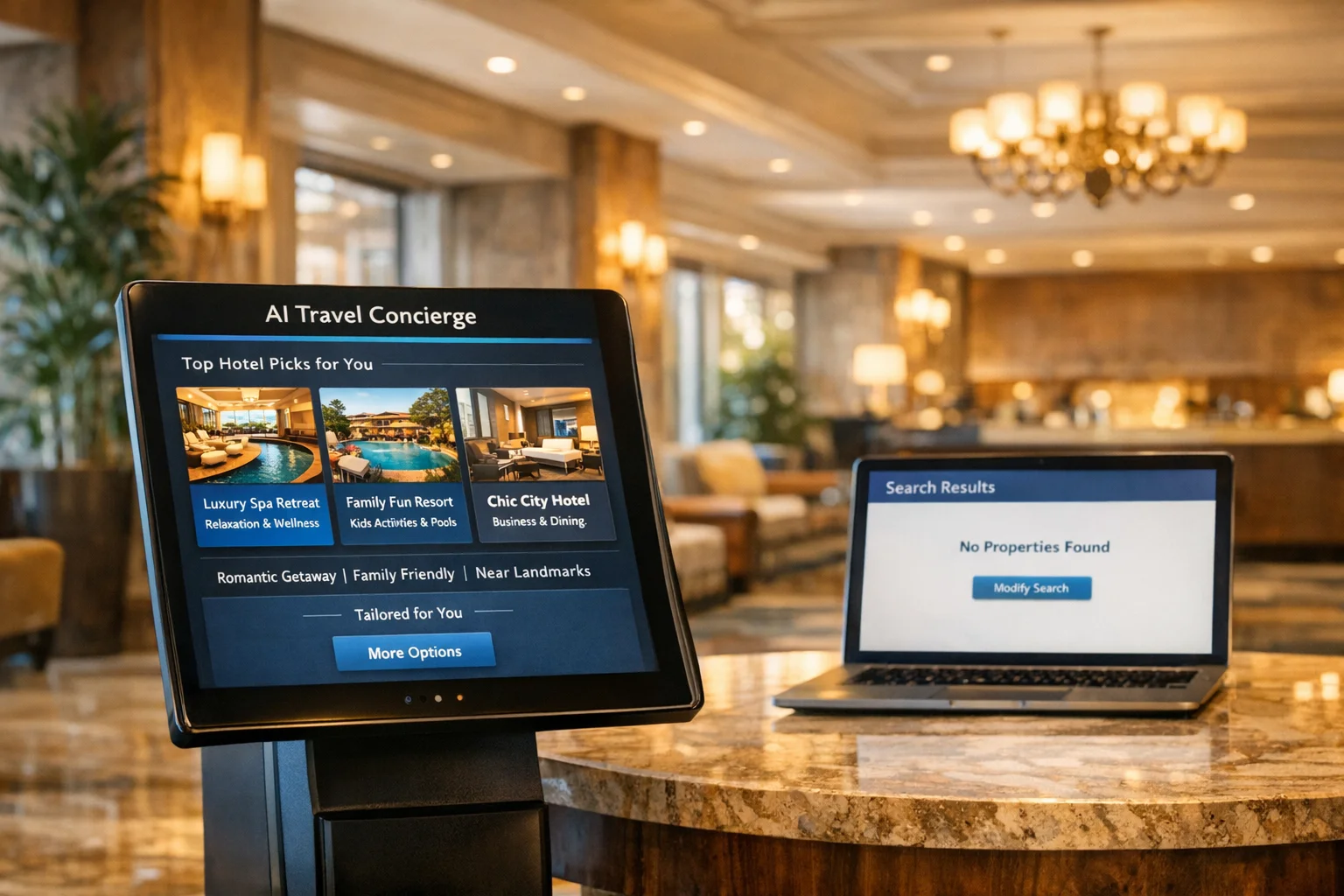
The travel booking stack is being rebuilt from the bottom up, and most hotels are still playing the old game.
AI travel agents don’t browse OTA listings like human travelers do. They don’t scroll through pages of properties or filter by star ratings on Booking.com. They synthesize recommendations from citations, reviews, structured data, and entity signals pulled directly from the open web.
Hotels that optimized only for OTA search are becoming invisible to this new layer of discovery. As Hotel-Online noted in its recent analysis of “Agentic Hospitality,” the shift from search-based to agent-based discovery is accelerating in 2026. The same week, Hospitality.today reported declining OTA front-end visibility as AI tools capture the early-stage planning conversation.
This isn’t a distant trend—it’s happening now. Hotels that haven’t adapted are already losing bookings to competitors that the AI agents actually see.
What is Agentic Travel Discovery?
Agentic travel discovery is the new pattern where travelers describe their intent to an AI agent—“Find me a boutique hotel in Bali with a pool, under $200/night, good for digital nomads”—and the agent returns a curated shortlist of 3-5 properties, not a page of 50 options.
The agent doesn’t browse. It reasons. It pulls from:
- Your official website content and structure
- Your Google Business Profile data and reviews
- Third-party citations (TripAdvisor, industry articles, press)
- Structured schema markup and entity consistency
- Review volume and sentiment patterns
As Hospitality.today’s recent coverage of “OTA front ends losing visibility” points out, this shift reduces the role of traditional metasearch and OTA listing pages as the primary discovery funnel. Travelers are still booking through OTAs in many cases, but the decision path increasingly starts with an AI agent that has already narrowed the field.
The implication: OTA optimization no longer guarantees visibility. You need a direct layer of AI-ready assets. For a side-by-side comparison of how AI-driven direct bookings stack up against OTA commissions, see our OTA vs direct booking AI visibility analysis.
Why OTAs Are Losing the Front Door
OTA listings are optimized for OTA search, not for AI citation. When an AI agent looks for hotels, it doesn’t query Booking.com’s internal database. It queries the open web, pulling signals from multiple sources and synthesizing them into a recommendation.
This creates a structural gap:
- OTA search optimization helps you rank when someone browses Booking.com or Expedia directly.
- AI agent visibility determines whether an AI agent even includes you in its shortlist.
If you only invested in OTA optimization, you’re winning a shrinking game. As Hospitality.today reported in its analysis of “The AI cost trap in travel,” many hotel marketing teams are still built for Google Ads + OTA optimization with zero playbook for AI agent visibility.
The fragmentation is real. TikTok is now testing hotel metasearch, adding another channel that pulls from web signals rather than OTA databases. The discovery surface is splintering, and AI agents sit at the top of the funnel.
What AI Agents Actually Look For
AI agents evaluate hotels through a different lens than OTA algorithms. They prioritize signals that indicate authority, trust, and machine-readability:
Structured Data & Entity Consistency
- Schema markup (Hotel, LodgingBusiness, LocalBusiness)
- Consistent NAP (name, address, phone) across all citations
- Clear price, availability, and booking path signals
- How Paltree measures these signals
Review Volume & Sentiment
- Total review count across platforms (Google, TripAdvisor, Booking.com)
- Review recency and response rates
- Sentiment patterns and keyword themes
- Owner response velocity (77% more likely to book when owners respond, per TripAdvisor research)
Content Architecture for AI Ingestion
- Clear, descriptive content that can be parsed by LLMs
- FAQ sections that answer common traveler questions
- Location context and nearby attractions
- Unique value propositions that differentiate from competitors
Direct-Booking Path Clarity
- Transparent booking process
- Competitive pricing signals
- Special offers or direct-booking incentives
- Mobile-optimized booking flow
Learn more about hotel-specific AI visibility
The Travel AI Score methodology breaks these signals down into measurable categories. Hotels scoring above 80 typically see 2-3x more AI citations than those below 50.
The Hotel Marketing Stack Gap
Most hotel marketing teams are built for a world that no longer exists. The typical stack looks like:
- Google Ads campaigns
- OTA listing optimization
- Basic SEO (meta tags, keywords)
- Social media posting
- Email marketing
What’s missing: an AI visibility layer that ensures you’re included in AI agent recommendations.
This gap is where travel brands and agencies need specialized help. The old playbooks don’t address:
- How to make your hotel citeable by ChatGPT, Gemini, and Perplexity
- How to structure your web presence for AI ingestion
- How to monitor which AI engines actually recommend your property
- How to compete against hotels that have invested in AI-first discovery
As Bizcommunity noted in its recent piece on “AI reshapes tourism visibility,” the hotels winning in this new environment aren’t necessarily the biggest chains—they’re the ones that adapted their digital presence for AI-first discovery.
Travel brands and agencies: Palmtree builds your AI visibility layer. See how a travel GEO agency can help.
What a Travel GEO Agency Does Differently
A travel GEO agency focuses specifically on making your hotel or travel brand recommendable across AI engines. Unlike generic SEO firms, travel GEO specialists understand:
AI Citation Monitoring
- Track which AI engines recommend your property
- Monitor recommendation frequency and context
- Benchmark against competitors in your market
- Alert when visibility drops or opportunities emerge
Structured Data Optimization
- Implement and validate hotel schema markup
- Ensure entity consistency across all platforms
- Optimize Google Business Profile for AI extraction
- Create llms.txt files for explicit AI guidance
Content Architecture for AI Ingestion
- Structure web content to be easily parsed by LLMs
- Develop FAQ sections that answer AI-common queries
- Create location-specific and amenity-rich descriptions
- Ensure pricing and availability signals are clear
Competitor Benchmarking
- See which competitors AI agents recommend in your market
- Understand why they’re winning recommendations
- Identify gaps in your AI visibility strategy
- Track changes in AI recommendation patterns over time
Learn how Palmtree’s travel GEO agency services work
The goal isn’t to replace your existing marketing stack—it’s to add an AI visibility layer that ensures you’re discoverable in the new agent-based travel planning paradigm.
First Step: See Where You Stand
You can’t fix what you can’t measure. Before investing in a full AI visibility strategy, understand your current baseline:
- Are AI travel agents recommending your hotel?
- Which engines include you, and which ignore you?
- How do you compare to competitors in AI citations?
- What specific signals are dragging down your visibility?
Run a free AI visibility audit for your hotel or travel business.
The audit checks your visibility across ChatGPT, Gemini, Perplexity, Claude, and other AI engines. It scores your structured data, review signals, content architecture, and entity consistency. Most hotels discover they’re invisible to at least 2-3 major AI engines.
From there, you can decide whether to implement fixes internally or partner with a travel GEO agency for execution.
FAQ
What is the difference between OTA optimization and AI visibility?
OTA optimization helps you rank when someone browses Booking.com or Expedia directly. AI visibility determines whether AI travel agents include your property in their recommendations at all. They’re separate funnels, and investing in one doesn’t guarantee success in the other.
How do I know if AI agents are recommending my hotel?
The only way to know is to test across multiple engines with different queries. Palmtree’s AI travel audit does this systematically, checking whether your property appears in recommendations for relevant traveler intents.
Can I fix AI visibility issues myself, or do I need an agency?
Some issues—like missing schema markup or inconsistent NAP data—can be fixed in-house. But ongoing AI citation monitoring, competitive benchmarking, and content architecture optimization often require specialized expertise. A travel GEO agency brings tools and playbooks that most hotel marketing teams don’t have.
How long does it take to improve AI visibility?
Initial fixes (schema, NAP consistency, basic content) can show results in 2-4 weeks. Deeper improvements (review strategy, content architecture, citation building) typically take 2-3 months. AI engines re-index and update their models continuously, so sustained improvement requires ongoing work.
Will AI agents eventually replace OTAs entirely?
Unlikely in the near term. AI agents and OTAs serve different roles. AI agents handle early discovery and shortlisting. OTAs handle the actual booking transaction and inventory management. The smart strategy is OTA-smart, not anti-OTA—maintain OTA presence while building direct AI visibility.
What if I’m a small boutique hotel with limited budget?
Start with the basics: claim and optimize your Google Business Profile, add hotel schema markup to your website, respond to every review within 24 hours, and ensure your NAP data is consistent across all platforms. These low-cost moves can significantly improve AI visibility. For more comprehensive support, even a basic AI audit can reveal the highest-impact fixes.
The travel discovery landscape is shifting from browse-based to agent-based. Hotels that adapt their digital presence for AI-first discovery will capture demand before it ever reaches an OTA search page. Those that don’t will see recommendation share drift to competitors.
The question isn’t whether AI agents will dominate travel planning—they already are. The question is whether your hotel is visible to them.